Experts say there is no verified evidence that the site houses uranium enrichment equipment. Its depth and restricted access continue to make independent assessment difficult.
US-Iran Conflict: US President Donald Trump’s latest warning against Iran has turned attention to Pickaxe Mountain, a little-known underground complex near the Natanz nuclear facility that Washington suspects that it could be used for advanced uranium enrichment activities. Hidden deep inside a mountain in central Iran, the site has become a possible target of US forces.
The US president recently said America would strike the facility if Iran had moved nuclear centrifuges there. He said the United States would launch a “very heavy attack… probably very soon” against the underground site. He later said, “We are going to take out Pickaxe Mountain. Tell the Iranians to be ready.”
The comments have put the spotlight on a facility that has been under construction for several years but has never been fully accessible to international inspectors. Iran says the complex is a highly protected centre meant for advanced centrifuge production and assembly, replacing parts of its Natanz operations.
However, its depth, size and secrecy have led Western officials and nuclear experts to examine whether it could have a broader role in Iran’s nuclear programme.
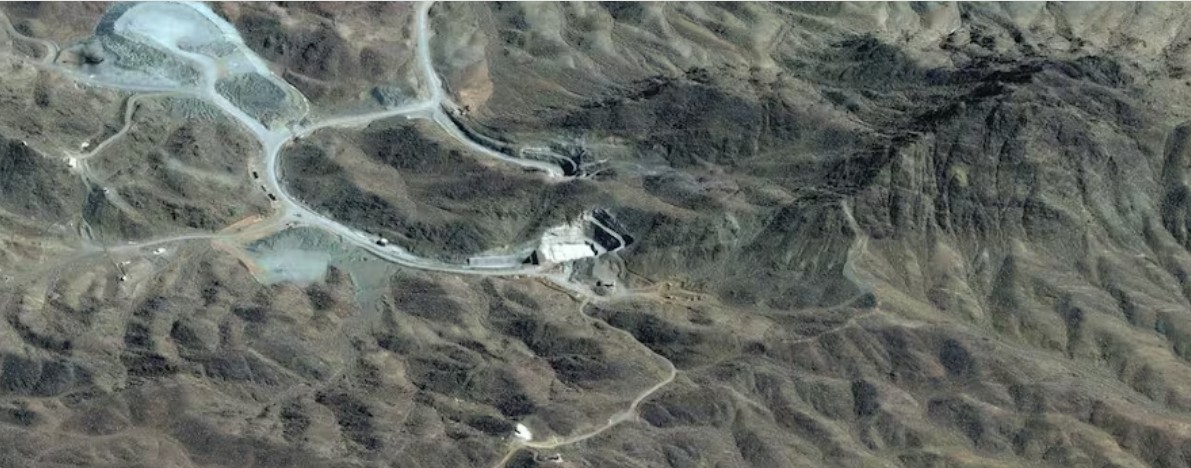
Also known as Kuh-e Kolang or Kolang Gaz La, the Pickaxe Mountain is located about 220 kilometres south of Tehran and roughly two kilometres from the Natanz nuclear site in Isfahan province. The facility is built inside a mountain and satellite images have shown multiple tunnel entrances on different sides of the site.
The project emerged after a 2020 explosion at the Natanz nuclear complex, which Iran described as sabotage. Several reports blamed Israel for the incident, although Tel Aviv never accepted responsibility. Months later, Iran’s then nuclear chief Ali Akbar Salehi announced plans for a newer and more advanced facility built inside a mountain to improve protection against possible attacks.
Satellite images from recent years have shown continued construction activity around the site. The Institute for Science and International Security (ISIS), a US-based research group, has said the mountain could contain several underground levels, although the exact design and purpose cannot be confirmed without access to internal plans.
Recent imagery has shown efforts to strengthen tunnel entrances, including construction work around access points. Analysts have said the facility appears designed to provide protection against military strikes and could potentially house advanced centrifuges capable of enriching uranium more efficiently.
Why US sees it as a difficult target
The challenge for Washington is the depth and unknown structure of the mountain. The United States used powerful bunker-busting weapons against Iran’s Fordow nuclear facility, including the GBU-57 Massive Ordnance Penetrator, a 13.6-ton bomb built to penetrate layers of earth and reinforced concrete.
However, experts say attacking the Pickaxe Mountain would be far more complicated because the underground layout is not fully known. The success of such a strike would depend on factors, including the type of rock, the depth of the tunnels and the location of any nuclear equipment in the complex.
Nuclear researcher Matthew Sharp from the Massachusetts Institute of Technology told The Wall Street Journal that an attack on the mountain may not produce the same results as the earlier strikes on other Iranian nuclear sites because of the limited information available about the facility’s internal structure.
Experts say that even if a direct strike cannot destroy every part of the underground complex, damage to entrances, electricity supplies and ventilation systems could affect future operations.
Iran denies nuclear activity at the site
Iran has rejected claims that the Pickaxe Mountain is being used for nuclear activities. On July 22, the country’s foreign ministry said that there was no nuclear activity taking place at the facility.
The ISIS has said the site appears large enough to support a small uranium enrichment operation using advanced centrifuges. Such machines can produce enriched uranium with fewer units compared with older models. However, the group has said it has no confirmed evidence that centrifuge cascades have been installed there.
Satellite images have also not shown features usually associated with nuclear reactors, such as cooling towers, spent fuel storage pools or large water supply systems. This has led experts to believe the site is more likely to house a uranium enrichment facility than a nuclear reactor.
Source : Zeenews