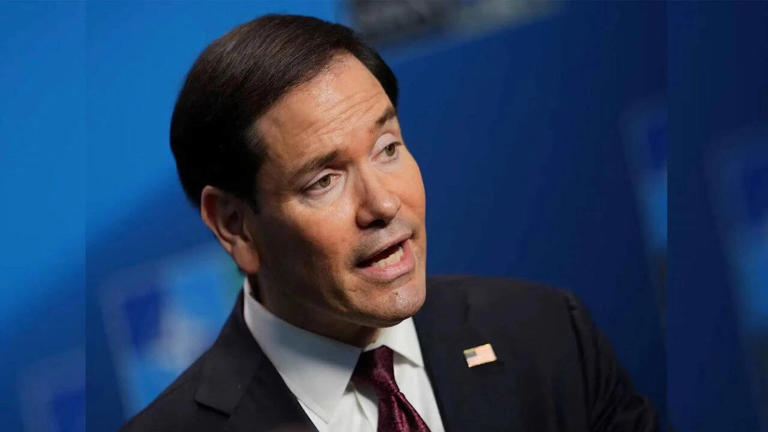
U.S. Secretary of State Marco Rubio has said the Iranian regime must fundamentally change its behaviour even if there is no formal regime change, arguing that Tehran’s long-standing ambition to project power across the Middle East must come to an end.
Speaking in an interview with Fox News’ My View with Lara Trump, Rubio stressed that Washington’s objective is not necessarily to replace Iran’s leadership but to ensure that the regime abandons what he described as its expansionist policies.
“The regime has to change. You may not have a regime change, but the regime has to change,” Rubio said.
He went on to describe what he sees as the core challenge posed by Tehran.
“The Iranian regime traditionally has been expeditionary. In essence, their view is they don’t want to just govern Iran, they want to govern the region. They want to export their revolution. That does have to change. And the only way you’re going to change that is if you make the price of it too high for them to be able to pay,” Rubio said.
His remarks come amid heightened tensions between Washington and Tehran, with the Trump administration continuing to pressure Iran while also leaving the door open for negotiations.
Rubio Says Iran Can No Longer Act Without Consequences
During the interview, Rubio argued that Iran is facing a fundamentally different U.S. administration under President Donald Trump than it has in previous decades.
“I don’t think the Iranian regime has ever faced a president like President Trump, which is someone that actually takes action,” Rubio said.
He added that Iran had become accustomed to avoiding meaningful consequences over the last two or three decades.
“They got used to, for 20 or 30 years, not just the U.S., but the broader world, allowing them to get away with things like lying, breaking deals, tricking people into agreements,” Rubio said.
According to Rubio, the Trump administration’s approach is intended to ensure that such actions carry tangible costs, reinforcing his argument that Tehran’s conduct, rather than simply its leadership, must change.
The comments also come as the White House has maintained that Iran “will continue to pay” until it returns to negotiations in what President Trump considers “a meaningful way,” following Tehran’s alleged attacks on commercial shipping and U.S. forces after signing a memorandum of understanding with the United States.
Trump Claims Framework for Deal Is Emerging
Rubio’s interview comes as President Donald Trump indicated that diplomacy may still prevail despite the ongoing conflict.
According to the Associated Press, Trump said in a Saturday evening social media post that Middle East allies have reached the parameters of a possible agreement to end the five-month-old Iran war.
Trump said the proposed framework would include the “Immediate, Complete, and Total OPENING OF THE HORMUZ STRAIT, and an end to Iran’s nuclear threat.” He also said he had agreed to hold off on ordering new military strikes for now.
“Based on this request, I have agreed, for the future benefit of the WORLD and, likewise, the survival of a successful and prosperous Iran, to cancel the attack, subject to being able to rapidly make a DEAL,” Trump wrote, according to AP.
Trump further claimed that Israel had agreed to work with the United States in an effort to complete an agreement with Iran that could bring the conflict to an end.
Saudi Arabia Raises Escalation Concerns
The Associated Press also reported that Saudi Crown Prince Mohammed bin Salman spoke with Trump on Saturday and expressed concern over the possibility of further U.S. military escalation against Iran.
According to AP, Saudi officials fear that if the United States strikes Iran’s energy infrastructure or other critical facilities, Tehran could retaliate by targeting energy infrastructure in Saudi Arabia and other Gulf countries.
The report said the crown prince sought clarity from Trump on the military options under consideration. The White House confirmed that the two leaders spoke but did not disclose details of their conversation.
Meanwhile, AP reported that the U.S. State Department has issued fresh security alerts for Americans in Bahrain, Israel, Iraq, Jordan, Kuwait, Lebanon, Oman, Qatar, Saudi Arabia and the United Arab Emirates, advising heightened caution amid the escalating tensions and warning of possible flight cancellations, temporary airspace closures and other travel disruptions.
Rubio’s remarks underscore the administration’s position that while negotiations remain possible, any future engagement with Tehran must be accompanied by a significant change in the Iranian regime’s regional behavior.
Source : MSN