Key Points and Summary – Vladimir Putin’s “colossal error” in Ukraine is setting the stage for a potential collapse of the Russian Federation, mirroring the Soviet Union’s decline after its disastrous war in Afghanistan.
-According to the author and analysts like retired Lt. Gen. Ben Hodges, Putin’s refusal to compromise is driven by “petulance,” not strategy.
Also Read :How Is Grok Different Than ChatGPT? Here’s What You Should Know
This obstinacy is leading to a catastrophic loss of global influence, the alienation of key allies, and a looming economic meltdown fueled by a massive fiscal deficit and plummeting oil prices.
-With Russian public support for the war dwindling, Putin’s obsession with Ukraine may prove to be his—and Russia’s—undoing.
Also Read :Trump’s approval rating has “started to drop more quickly”—Nate Silver
The ‘Beginning of the End’: Is Russia Headed for a Soviet-Style Breakup?
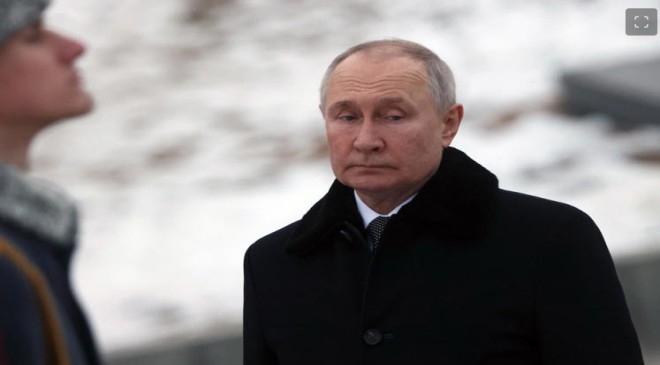
WARSAW, POLAND – “Putin’s refusal to compromise on Ukraine, analysts say, is a colossal error costing Russia regional influence, lucrative energy markets and its place in the world,” reads the opening line to a recent article in the US newspaper, the Washington Post.
The subtext of the message being delivered by different analysts is that the refusal of the Russian President, former KGB Lt. Col. Vladimir Vladimirovich Putin, to change strategy or brook any compromise on the future course of his war in Ukraine is causing irreparable damage to his country.
This is not just the opinion of a single columnist of one American newspaper. The list of those who see long-term disastrous consequences for Russia – individuals both well-known and known only to those of us who have lived and worked in Russia in the past – grows by the day.
Also Read :Kremlin says peace with Ukraine hinges on ‘achieving our goals’
After the February 2022 full-invasion of Ukraine, one of the first to come out with dire predictions for the future of Putin’s homeland was retired US Army Lt. Gen. Ben Hodges. The retired three-star was the former head of European Command EUCOM and was also the one-time Pershing Chair for Strategic Studies at the Centre for European Policy Analysis (CEPA).
Hodges’s dire predictions for the disintegration of Moscow’s sprawling landmass began in the latter half of 2022, when he spoke on the subject with the Australian Broadcasting Service (ABC OZ).
A Warning to Russia – Predictions and What Leads to Collapse
Putin’s failure to successfully defeat Ukraine could be the beginning of the end for the Russian Federation, summarizing his assessment.
“There are centrifugal forces at work that are going to pull it apart,” he told Australia’s ABC News Daily podcast. “I believe we need to be prepared for the possibility of the break-up of the Russian Federation.”
This sentiment is now one increasingly expressed among Russia-watchers and those analysing the impact of the war in Ukraine.
Also Read :‘No One Is Above Law’: Donald Trump Stirs Controversy, Posts AI-Video Of Barack Obama’s Arrest
It is also not the first time in Russian history that this has occurred – what seemed at the time to be a small-scale failure with cascading effects ultimately led to the end of an empire.
Ukraine is a nation orders of magnitude smaller than Russia and with none of its endless resources. But it is becoming another “David and Goliath”-type confrontation in which Russia has come out on the losing end.
In 1979, the USSR invades Afghanistan and is forced to withdraw a decade later – having lost 15,000 military personnel and achieved almost none of the objectives that prompted the incursion in the first place.
In late 1981 and under pressure from the Soviet Union, the Communist Party here in Poland instituted martial law to stamp out the Solidarity labor movement that was agitating for political freedoms. This period of repression ended in 1983, but instead of seeing the Solidarity movement dismembered Poland experienced even greater labor unrest.
Also Read : Trump Claims US Halted India-Pakistan Conflict, ‘Five Jets Shot Down’; India Reacts Strongly
By the end of the decade, the Polish Communist authorities are forced to bring the organization’s leaders into a cohabitation government, which eventually causes its dissolution and the creation of the modern, democratic Polish state.
Both instances are today assessed as the watershed moments that were the beginning of the end for the Soviet Union.
Moscow’s efforts to hold onto the empire by force in response to these initial indicators that the system was collapsing from within only accelerated that decline.
Petulance Triumphing Over Common Sense Created Russia’s Situation Today
Russian officials today explain Putin’s determination to prosecute the war as a necessary, strategic imperative and that this is the only way to “save Russia from NATO aggression” and “Ukrainian Nazis.”
However, most Western analysts view his continued petulance in continuing the war without regard for its effects on the nation and his refusal to compromise on any of his maximalist demands for a peace agreement as fatal, strategic errors.
The ultimate price will be a near-complete loss of Russia’s global influence, its few allies deciding to decouple from Moscow, and a loss of the energy export markets keeping the economy alive is the likely outcome.
Putin, writes the UK Independent correspondent Owen Matthews today, “is living on borrowed time.”
“Russia has begun running a fiscal deficit of some 1.5 per cent of GDP,” he observes.
“And most seriously of all, global oil prices have fallen a precipitous 35 per cent this year. As a result, Russia’s Central Bank is set to print 15 trillion roubles (£142bn) in cash come October – the largest issuance since the hyperinflation of the 1990s.”
“Putin, evidently, remains set on pursuing his obsession with subjugating Ukraine, apparently at any cost,” he continues. “Polls suggest that the number of ordinary Russians who agree with their leader’s dogged obsession is dwindling.”
“According to a study by Levada, Russia’s last independent pollster, in June, 64 per cent of respondents favored peace talks, which is six percentage points up since March. At the same time, the number of people who wanted the war to continue fell to 28 per cent, down from 34 per cent in March. “
There are no indicators that this downward trajectory of these economic trends will alter. Further eroding the population’s support for the war is the continued increase in both Ukrainian drone attacks on Russian cities and economic deterioration across the nation will only further erode. The combination is likely to lead to the collapse of the Russian state.
One might expect Putin to have the foresight to understand the perils of continuing to pursue a course of action that has led his country to the brink of instability. But there is very little evidence to suggest that he is willing to do so, which could very well be his – as well as Russia’s – undoing.
About the Author: Reuben F. Johnson
Reuben F. Johnson has thirty-six years of experience analyzing and reporting on foreign weapons systems, defense technologies, and international arms export policy. Johnson is the Director of Research at the Casimir Pulaski Foundation. He is also a survivor of the Russian invasion of Ukraine in February 2022. He worked for years in the American defense industry as a foreign technology analyst and later as a consultant for the U.S. Department of Defense, the Departments of the Navy and Air Force, and the governments of the United Kingdom and Australia. In 2022-2023, he won two awards in a row for his defense reporting. He holds a bachelor’s degree from DePauw University and a master’s degree from Miami University in Ohio, specializing in Soviet and Russian studies. He lives in Warsaw.