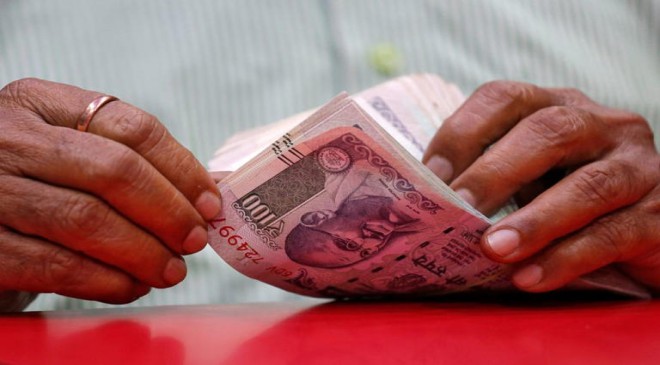
MUMBAI, Jan 28 (Reuters) – The Indian rupee closed marginally weaker on Wednesday, lagging Asian peers, on dollar demand linked to maturing non-deliverable forwards positions and month-end importer demand, while positive cues from a broad-based decline in the greenback capped losses.
The rupee ended at 91.7825 per dollar, 0.1% down from its close at 91.72 in the previous session.
The currency has weakened about 2% so far this month, making it the worst performer among its Asian currencies, as investors continue to fret over persistent foreign portfolio outflows from equities. Outflows have already touched $4 billion in January.
Also Read:Tesla stock investors just got good news from CEO Elon Musk about robotaxis and robots
INR “continues to be very flow-dependent and is showing little sensitivity to global cues,” a foreign bank trader said.
Unless the underlying flows across hedging activity and investments turn supportive, staggered depreciation will likely persist, the trader added.
On the day, intermittent dollar sales from state-run banks and likely central bank presence in the non-deliverable forwards market helped limit the currency’s losses, according to traders.
Most Asian currencies, meanwhile, were up between 0.1% and 0.9% while the dollar index struggled to meaningfully bounce back from a four-year low hit in the previous session after President Donald Trump brushed off its recent weakness.
“The move looked to be driven by FX decision-makers – be the asset managers hedging U.S. risk or the speculative community (hedge funds and CTAs) adding to short-dollar positions on range breakouts,” analysts at ING said in a note.
Global markets will now hone in on the U.S. Federal Reserve’s monetary policy decision, due later in the day.
While there is no change expected in benchmark borrowing costs, the focus will be on commentary from Fed Chair Powell regarding the future interest rate trajectory and the ongoing challenges to the independence of the U.S. central bank.
President Donald Trump is sounding the alarm as the Supreme Court prepares to rule on the legality of his sweeping global tariffs — a decision he says could throw the U.S. economy into chaos.
With billions already collected and legal challenges piling up, Trump is warning that if the court blocks him from continuing to carry out his trade plan, the fallout could be massive and nearly impossible to unwind.
Also Read:Your daily horoscope: January 28, 2026 predictions

Trump has argued that striking down his tariffs would trigger years of financial confusion as businesses demand refunds for taxes already paid.
Also Read:Your daily horoscope: January 24, 2026 predictions
In a lengthy social media post, the president warned that the U.S. would be in trouble if the court rules against him, writing, “WE’RE SCREWED.”
He added that reversing the policy would be nearly impossible, claiming, “it would take many years to figure out what number we are talking about and even, who, when and where, to pay.”
Also Read:The US dollar just fell and the reason is clear
“It would be a complete mess, and almost impossible for our Country to pay,” Trump added.
The case is a major test of Trump’s authority and his economic strategy — and the court has already shown skepticism.
Trump’s authority under scrutiny

Trump’s tariffs, which he first announced last April, are being challenged by small businesses and a coalition of 12 states that argue he overstepped his authority by imposing global levies on imported goods.
Also Read:What Russia’s ‘Anchorage formula’ for Ukraine really means, according to Reuters
Two lower courts agreed, finding Trump did not have the power to impose the tariffs, which do not have congressional approval.
The administration is relying on the International Emergency Economic Powers Act, a 1977 law that allows presidents to regulate international transactions during national emergencies.
At a November hearing, justices questioned that legal justification.
While refunds were not a major focus, Justice Amy Coney Barrett warned that undoing the tariffs could itself become a “complete mess.”
The Supreme Court, which has a 6-3 conservative majority, is expected to rule soon.
Levying more tariffs

Even as the legal battle plays out, Trump is expanding his tariff threats overseas.
In recent days and weeks, he announced that any country doing business with Iran would face a 25 percent tariff on trade with the U.S.
“Effective immediately, any Country doing business with the Islamic Republic of Iran will pay a Tariff of 25% on any and all business being done with the United States of America,” Trump wrote on Truth Social. “This order is final and conclusive.”
He threatened to levy steep import duties on eight American allies in Europe — Denmark, Norway, Sweden, France, Germany, Britain, the Netherlands and Finland — if they did not support his takeover of Greenland, which is an autonomous Danish territory. Trump has since backed down.
Also Read:Analysts suggest Europe learned a lesson on Trump
But days later, he announced he’s increasing tariffs on goods from South Korea from 15 percent to 25 percent.
The impact of Trump’s tariffs, which are paid by U.S. importers, have been felt for months. Volkswagen, for example, reported that U.S. sales fell 8.2 percent last year, explaining that tariffs “had a marked impact on deliveries in North America.”
Source : Msn