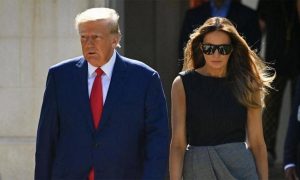
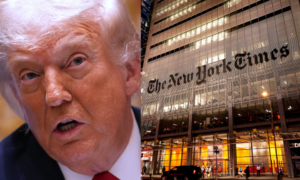
Since returning to office in January 2025, Donald Trump has set about stamping his name across the American landscape with an intensity that goes well beyond familiar political branding.
What might once have been limited to hotels and golf courses now stretches into public infrastructure, federal programmes and even national symbols, blurring the line between personal brand and state identity.
Also Read :How Trump approval rating has changed since White House shooting
Soon, Americans could even have Mr Trump’s name on their person, with the announcement on Wednesday that his face and signature were expected to be placed on American passports to commemorate the nation’s 250th year.

The US treasury has reportedly announced plans to place Trump’s signature on future currency, alongside new gold coins, $1 coins, and commemorative $100 “Trump bills” tied to the upcoming anniversary.
An unprecedented move for a sitting president, it would push against a long-standing federal statute from 1866 that prohibits living people from appearing on US currency, setting up an inevitable legal challenge.
If that happens, it will by no means be the first time Mr Trump has battled a lawsuit over his naming initiatives.
The renaming of the Kennedy Centre for the Performing Arts in 2025 to include Mr Trump’s name prompted heated controversy, including a lawsuit from Joyce Beatty, a representative from Ohio.
Around the same time, his name was added to the US Institute of Peace building. Large signs showing the president’s likeness were hung in federal office buildings, including the headquarters of the department of justice, the department of agriculture and the department of labour.
Adam Schiff, a Democratic representative, claimed Mr Trump had used $50,000 (£37,000) of American taxpayers’ cash to create the banners.
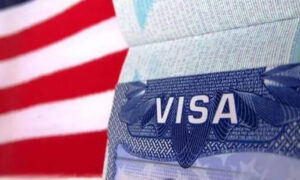
There’s even a visa scheme spearheaded bearing the Trump name. But it’s not cheap. One could apply for a “Trump Gold Card” visa by submitting an application with a $15,000 (£11,000) fee. Upon completion of the vetting process, a $1m gift “is evidence that the individual will substantially benefit the United States”.
The Gold Card programme was unveiled in February 2025, with the president predicting that “it’s going to sell like crazy”.
Not so far. It has received only 338 applications, according to a court filing. Of those, 59 applicants had progressed to a further stage with the homeland security department, which is vetting applications.

Tension over the Trump name has also extended into cultural and civic infrastructure.
Ongoing legal challenges question national park passes featuring Mr Trump’s image alongside George Washington, with critics arguing this violates federal rules governing pass design.
Also Read :Bitcoin stuck at $76,000: Why is it not moving?
Meanwhile, proposals have surfaced to rename major transport hubs in his honour – including Washington Dulles Airport, Palm Beach International Airport and Penn Station – efforts that, even when unsuccessful, show how widely the idea has spread in Republican politics.
Government-sponsored programmes have also come to bear the Trump name. TrumpRx, a prescription drug website of the US government, was created to find medications at low prices.
Another initiative, Trump Accounts, is aimed at under-18s, offering tax-advantaged investment accounts to “jump-start the American Dream”.
Also Read :Donald Trump’s latest move is pathetic – but also terrifying
They are to be bankrolled by Michael Dell, the US computer seller, and his wife, Susan, who have pledged $6.25bn (£4.6bn) to “seed fund” the project.

Greg Steube, a Republican representative from Florida, has proposed a bill to rename Washington’s metro rail system the “Trump Train”, and to rework the Washington Metropolitan Area Transit Authority into the “Washington Metropolitan Authority for Greater Access”, creating the acronym “WMAGA” in a nod to Mr Trump’s slogan.
Naval warships are also being named in Mr Trump’s honour, and the scope of this naming push shows little sign of stopping at US borders.
Also Read :4 things you missed from Elon Musk’s testy second day on the stand at OpenAI trial
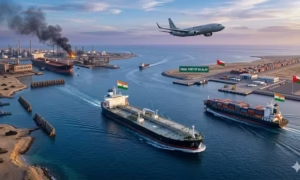
Abroad, Trump-branded properties have multiplied across dozens of countries. Even symbolic gestures – such as a gold statue at a Florida golf course or a social media post renaming the Strait of Hormuz as the “Strait of Trump” – extend the reach of the brand into increasingly theatrical territory.

Sceptics suggest the pattern reflects something less strategic than psychological. Maura Gillespie, a former Republican Party adviser, argued the president’s drive to attach his name so widely stems from “insecurity and fears over his legacy”.
Others have treated it with humour. The Daily Show aired a fictional skit in which a professional naming expert, hired by the president, descends into madness under the weight of naming so many things.
Jeffrey Sonnenfeld and Steven Tian, of Yale’s chief executive leadership institute, argued in a published paper that Mr Trump’s motive behind his self-branding is to instil the illusion of power and success. “Trump’s obsession with grandiosity is an inevitable fragility beneath all the glitz and glamour,” they wrote.
Mr Trump himself has long been explicit about the value of branding. In a 1999 interview, he described the use of his name as a way to increase commercial appeal. What has changed is scale: what once functioned as private enterprise branding has now migrated into the machinery of government.
Source:Msn