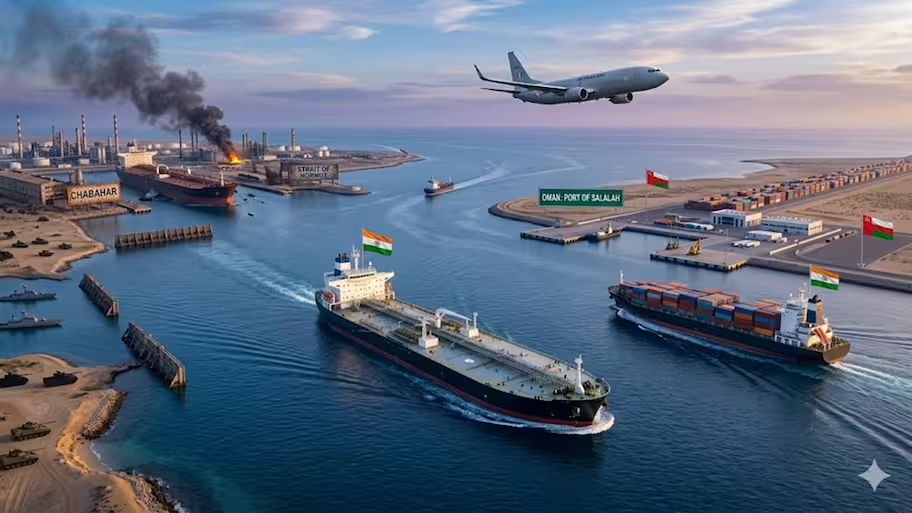
On a map, Fujairah appears to offer India precisely what it needs: an energy port on the United Arab Emirates’ eastern coast, facing the Gulf of Oman and sitting outside the Strait of Hormuz.
But a port’s location does not, by itself, determine whether an energy shipment has escaped the strait. The crucial questions are where the oil or gas originated, how it reached the port and whether a pipeline exists to carry it across the Arabian Peninsula.
Indian refiners and energy importers are increasingly relying on Fujairah and Khor Fakkan in the UAE to reduce their exposure to Hormuz, Mint reported, citing three people familiar with the matter. The 406-km Habshan–Fujairah oil pipeline, Oman’s Sohar port and Saudi Arabia’s East-West pipeline to Yanbu are also being used as alternative supply routes, according to the report.
These alternatives can protect part of India’s energy trade. But their usefulness differs sharply across crude oil, liquefied natural gas and cooking gas.
Why India needs an escape route
India sourced around 60 percent of its crude oil imports, 54 percent of its LNG imports and 90 percent of its LPG imports from West Asia through the Hormuz route before the war, according to the figures reported by Mint.
That exposure matters because India imports the overwhelming majority of the crude oil it consumes. Even when physical supplies continue, attacks, military escorts and uncertainty around shipping can raise freight and insurance costs, ultimately increasing the country’s import bill.
The security situation has deteriorated again. Five commercial ships, three crude supertankers, an LNG carrier and a container ship, were attacked in Omani waters between July 7 and July 15, according to a Reuters analysis of maritime incident data. Some shipping companies have consequently declined to use a US military-guided transit arrangement through Hormuz, citing concerns over crew safety. Reuters
The latest attacks make India’s search for routes outside the strait more urgent. They also demonstrate that being outside the narrow Hormuz shipping lanes does not necessarily put a vessel beyond the conflict’s reach.
What Fujairah can genuinely bypass
Fujairah provides a genuine Hormuz bypass for crude produced in the UAE and transported overland.
The Abu Dhabi Crude Oil Pipeline, also called the Habshan–Fujairah pipeline, can carry around 1.5 million barrels of crude per day from Abu Dhabi’s oilfields to Fujairah. Tankers can then load the UAE’s Murban crude directly from the Gulf of Oman without entering the Strait of Hormuz.
Fujairah exported an average of more than 1.7 million barrels per day of crude and refined fuels in 2025, according to Kpler data cited by Reuters. It also has about 18 million cubic metres of storage capacity and is a major global centre for blending and refuelling ships. Reuters
For India, this makes Fujairah a credible alternative loading point for UAE crude and products already stored or blended at the port.
The limitation is that the pipeline primarily solves the UAE’s export problem. Oil produced in another Gulf country does not automatically gain access to Fujairah merely because an Indian buyer wants the cargo loaded there. It must first reach the port through a pipeline, an overland network or a sea journey that may itself involve Hormuz.
Why Fujairah does not fully solve the Qatar LNG problem
Mint reported that UAE ports are also being used to route energy supplies originating in other Gulf countries, including Qatari LNG.
Fujairah can serve as a storage, transfer or onward-shipping point after a cargo reaches the UAE’s eastern coast. But Qatar’s principal LNG export facilities are at Ras Laffan, inside the Gulf.
Therefore, a Qatari LNG cargo moved by sea to Fujairah must first pass through Hormuz. Transferring it at Fujairah may alter the next leg of the voyage, but it does not eliminate the initial exposure to the strait.
This distinction has become particularly important for gas supplies. No LNG carrier transited Hormuz between July 11 and July 13 as security risks intensified, according to Kpler data reported by Dow Jones Newswires. The strait remains Qatar’s only maritime export route for LNG cargoes travelling beyond the Gulf, as per Barron’s report.
Omani LNG is different. Cargo originating at Oman’s facilities outside Hormuz can travel directly into the Arabian Sea. But Oman’s available production and export capacity cannot simply replace the much larger volumes associated with Qatar.
Saudi Arabia has a bypass but it brings another chokepoint
Saudi Arabia can move crude from its eastern oil-producing region across the country through the East-West pipeline to Yanbu on the Red Sea.
The pipeline’s pumping capacity was restored to around seven million barrels per day in April after earlier attacks disrupted operations, the Saudi energy ministry said. It served as the kingdom’s only crude-export route when Hormuz was closed.
For Indian refiners, however, loading Saudi crude at Yanbu produces a considerably longer voyage. A vessel must travel south through the Red Sea and cross Bab el-Mandeb before entering the Gulf of Aden and Arabian Sea. Alternatively, it would have to sail around Africa.
That route has acquired its own security risk. Iran has signalled that the Bab el-Mandeb gateway could become another pressure point through the Tehran-aligned Houthis in Yemen. Commercial shipping was previously forced to divert around southern Africa following Houthi attacks in the Red Sea.
Yanbu consequently reduces India’s reliance on Hormuz, but it does not remove exposure to longer sailing times, higher freight costs or conflict around another important waterway.
Crude can be rerouted more easily than LNG or LPG
Crude oil has the most developed escape routes because the UAE and Saudi Arabia have pipelines connecting their eastern production regions to ports outside Hormuz.
The same infrastructure cannot automatically carry LNG or LPG.
LNG requires liquefaction plants, cryogenic storage, specialised terminals and dedicated carriers. A conventional crude pipeline ending at an oil port cannot be repurposed as an immediate LNG export route.
LPG also requires specialised storage and loading facilities. Saudi Arabia’s East-West crude pipeline, for instance, does not create a like-for-like bypass for every propane or butane cargo normally loaded at a Gulf terminal.
This makes India’s high dependence on West Asian cooking-gas imports particularly significant. Directing vessels towards a different port works only if sufficient LPG is already available at that port or can be transported there through suitable infrastructure.
The ports themselves have capacity limits
Fujairah and Khor Fakkan cannot absorb every cargo that would otherwise move through the UAE’s much larger Gulf-facing ports.
In March, DP World chief executive Yuvraj Narayan said the eastern ports lacked the capacity to replace the throughput of Jebel Ali in Dubai and Khalifa Port in Abu Dhabi. Khor Fakkan could handle around five million twenty-foot equivalent units of container cargo, while Fujairah’s container capacity was below one million, Reuters reported.
DP World is reportedly planning a new multipurpose port and container terminal in Fujairah to reduce dependence on Jebel Ali. However, Reuters said it could not independently verify the Financial Times report on the project. Even if completed, new infrastructure would address future resilience rather than India’s immediate supply requirements.
An escape valve, not a complete escape
UAE and Saudi pipelines have already proved useful. In April, India’s crude imports from the UAE rebounded to nearly 670,000 barrels per day, while Saudi supplies stood at about 620,000 barrels per day, according to Kpler data cited by Reuters.
The UAE and Saudi Arabia remain the only Gulf producers with operating crude-pipeline routes that bypass Hormuz. Kuwait, Iraq, Qatar and Bahrain continue to rely on the waterway for most seaborne exports.
India has also increased crude purchases from suppliers such as Brazil, Venezuela, Angola and Nigeria. Diversifying the countries of origin offers protection that redirecting cargoes between nearby Gulf ports cannot provide on its own.
Fujairah is therefore an important escape valve for India’s energy trade, particularly for UAE crude. But it is not a substitute for Hormuz across all fuels, and it cannot insulate supplies from a conflict that is spreading beyond the strait itself.
Source : MSN