The latest round of fighting began after the United States accused Iran of targeting commercial shipping in the Strait of Hormuz
Barely weeks after the US and Iran appeared to have stepped back from a wider conflict, the Strait of Hormuz has once again become the centre of a rapidly escalating military confrontation.
The latest round of fighting began after the United States accused Iran of targeting commercial shipping in the Strait of Hormuz, one of the world’s most critical maritime trade routes. Washington described the attacks as an assault on freedom of navigation and responded with one of its largest military operations since the ceasefire.
On July 9, US Central Command (CENTCOM) announced that it had carried out fresh strikes on around 90 Iranian military targets, including missile launch sites, drone infrastructure, air-defence systems, coastal radar installations, naval assets and command-and-control facilities. According to CENTCOM, the objective was to “degrade Iran’s ability to threaten international shipping” in the Strait of Hormuz.
Also Read : ‘I Am Target Number 1’: Trump Says Iran May Be Plotting To Assassinate Him
The Sequence Of Events
The latest escalation has unfolded rapidly.
July 6-7: Rising Tensions Despite Diplomacy
Although indirect diplomatic contacts between Washington and Tehran had continued after the earlier ceasefire arrangements, tensions steadily mounted over alleged Iranian military activity around the Strait of Hormuz. US officials said Iran had been rebuilding military capabilities in the region even while negotiations remained technically alive.
July 8: Ceasefire Collapses
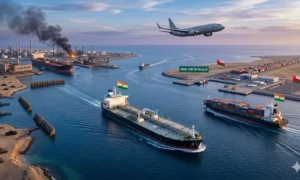
The immediate trigger came when the United States accused Iran of carrying out attacks against multiple commercial vessels transiting the Strait of Hormuz. According to US officials, the IRGC fired at least two missiles at the vessels. The attacks reportedly involved a combination of missiles and drones. While there were no reported fatalities, at least two ships suffered significant damage, prompting an immediate international security response. Iran has not acknowledged carrying out the strikes and has disputed the US narrative.
Among the vessels hit was the Qatari LNG tanker Al Rekayyat, which suffered a projectile strike that ignited a fire in its engine room while sailing near Oman. All crew members were safely evacuated and the LNG cargo remained intact, preventing a catastrophic explosion. The incident marked the first reported strike on a Qatari LNG carrier during the current conflict.
The attacks also damaged a Saudi-linked tanker and a Liberia-flagged supertanker, according to Reuters. Following the incidents, the US military raised the threat level in the Strait of Hormuz to “severe”, while the UN’s International Maritime Organization advised commercial vessels to avoid the area if possible. Shipping traffic through the Strait reportedly dropped sharply, from around 125-140 tankers a day before the conflict to just four vessels immediately after the attacks.
The Trump administration described the attacks as a direct assault on international freedom of navigation, arguing that commercial shipping had become the latest target despite the ceasefire framework agreed only weeks earlier.
Calling the attacks unacceptable, US President Donald Trump declared that the ceasefire was effectively “over” and warned that the US military would respond.
CENTCOM subsequently launched a large-scale wave of strikes across Iran, targeting military infrastructure linked to missile, drone and anti-ship operations. US officials described the operation as a direct response to attacks on civilian shipping rather than an attempt to widen the conflict.
Iran retaliated within hours by launching strikes against US military facilities in Bahrain and Kuwait. Both countries activated air-defence systems, while authorities issued public safety advisories as missiles and drones targeted American installations.
July 9: Fresh US Strikes And Sharper Warnings
Rather than easing, the confrontation intensified further. CENTCOM confirmed another round of strikes on nearly 90 military targets inside Iran, saying the attacks were aimed at preventing further threats to international shipping through Hormuz.
Oil prices climbed again as markets reacted to fears that shipping through the strategic waterway could face renewed disruption. Roughly one-fifth of global oil and LNG trade normally passes through the Strait of Hormuz, making any military confrontation there a major concern for global energy markets.
Trump’s Latest Warning
Following the latest strikes, President Donald Trump issued one of his strongest warnings yet to Tehran. “It will get much worse,” Trump said, warning that any further Iranian aggression would invite an even stronger American military response.
At the same time, Trump claimed Iran had contacted Washington after the strikes and was looking to negotiate. “They called a little while ago,” Trump said, adding that Iran “wants to make a deal badly.” However, no Iranian official has publicly confirmed Trump’s claim that Tehran initiated fresh talks.
Iran Rejects US Claims
Iran has strongly rejected Washington’s position. Iranian Parliament Speaker Mohammad Bagher Ghalibaf accused the United States of violating the ceasefire through its renewed military operations and insisted that Tehran would continue defending its interests in the Strait of Hormuz.
Ghalibaf also asserted that Iran remained in control of the strategic waterway and criticised the latest American strikes as another example of Washington abandoning diplomacy in favour of military pressure.
The Bone Of Contention: Strait Of Hormuz
The Strait of Hormuz connects the Persian Gulf with the Gulf of Oman and the Arabian Sea. It is among the world’s busiest maritime chokepoints, with around 20 per cent of global oil and significant volumes of liquefied natural gas passing through it.
Because of this, even limited military incidents in the waterway can send insurance premiums, freight costs and crude oil prices sharply higher.
For years, Iran has viewed the Strait as one of its most powerful strategic pressure points during confrontations with the United States and its allies. The US, meanwhile, considers freedom of navigation through Hormuz a core security interest and has repeatedly maintained a strong naval presence in the region.
What Happens Next?
Despite the renewed military exchanges, both Washington and Tehran continue to leave the door open, at least publicly, for diplomacy.
However, the events of the past three days illustrate how fragile the ceasefire had become. Commercial shipping attacks, retaliatory airstrikes, missile exchanges involving US bases in the Gulf and increasingly aggressive rhetoric from both sides have once again pushed the region closer to a wider confrontation.
Whether the latest escalation remains limited or develops into another prolonged phase of the conflict will depend on what happens next in the Strait of Hormuz, where a single incident now has the potential to trigger consequences far beyond the Gulf.
Source : News18