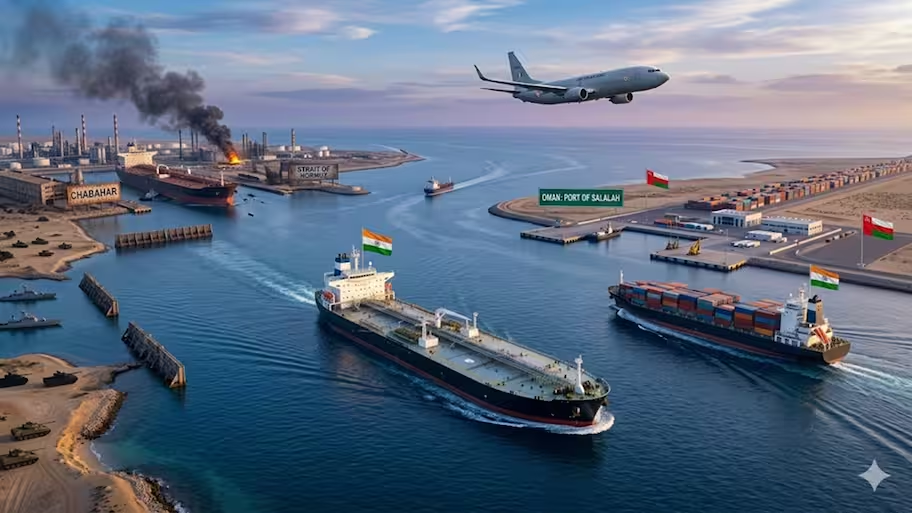
The West Asia tension has already spiked the prices of petrol, diesel, CNG and LPG in the country, and a collapse of the peace deal could instantly revive maritime hostilities in the Strait of Hormuz.
While the United States and Iran are hailing the signing of the Memorandum of Understanding for the peace deal, Israel has adopted a cautious approach towards the agreement, saying it’s led by US President Donald Trump. The diplomatic euphoria surrounding the upcoming US-Iran peace framework underscores just how high the stakes are for West Asian stability. However, the risk of the deal unravelling remains a distinct possibility with structural friction points between Washington, Tehran, and Tel Aviv left unaddressed. For India, a return to active regional hostility is not merely a foreign policy headache. Any collapse of it poses an acute threat to India’s economic stability and long-term maritime ambitions.
Also Read : World leaders welcome US-Iran peace deal as diplomatic breakthrough for regional stability
Twin Vulnerabilities: Energy Sabotage and Frozen Corridors
The key risk for New Delhi lies in the immediate fallout on energy markets and strategic connectivity. The West Asia tension has already spiked the prices of petrol, diesel, CNG and LPG in the country, and a collapse of the peace deal could instantly revive maritime hostilities in the Strait of Hormuz. The vital corridor handles over 20% of global oil traffic. With Brent crude projected to spike significantly in a crisis scenario, India’s high import dependence exposes it to a widening current account deficit and severe fiscal pressure.
Simultaneously, a re-imposition of heavy US secondary sanctions would paralyse India’s investments in Iran’s Chabahar Port and the wider International North-South Transport Corridor (INSTC). Despite hard-won commercial agreements, global logistics firms and financial institutions would rapidly retreat from the region to shield themselves from U.S. Treasury penalties, freezing India’s sovereign gateway to Central Asia.
Furthermore, a prolonged conflict across the Levant puts an indefinite hold on the India-Middle East-Europe Economic Corridor (IMEC). If commercial vessels are forced to avoid the Red Sea entirely, the resulting spike in freight rates and insurance premiums would hit Indian exporters hard, while threatening the livelihoods and multi-billion-dollar remittance flows of the nine million Indian expatriates working in the Gulf.
Strategic Countermeasures: Way forward for India
To build resilience against a potential regional fallback, India must execute a multi-layered mitigation strategy, right from securing alternative logistics gateways, insulating energy demands, and taking Gulf nations on-board for mini-lateral maritime security mechanisms.
* Logistics Gateways: Rather than relying entirely on corridors vulnerable to regional chokepoints, India is likely to gradually leverage its newly enacted Comprehensive Economic Partnership Agreement (CEPA) with Oman. Utilising the standard trade routes through Omani ports like Sohar, Salalah, and Duqm allows Indian cargo to bypass the volatile Strait of Hormuz entirely. This will ensure a stable, uninterrupted flow of goods directly into the wider GCC marketplace.
* Insulating the Energy Basket: To counter sudden price shocks, the government must aggressively fill the remaining capacity of its existing Strategic Petroleum Reserves (SPR). There is a need not only to accelerate the public-private partnership expansions in this direction but also to increase the SPR capacity. Simultaneously, long-term supply diversification must shift further toward non-Middle Eastern producers in West Africa and North America, alongside an increased domestic push for biofuels.
* Proactive Arabian Sea Mini-laterals: On the diplomatic front, India must pivot away from reactive posturing. By establishing localised, functional mini-lateral maritime security mechanisms with regional partners like the UAE and Oman, New Delhi can safeguard key shipping lanes and protect its commercial vessels without getting entangled in broader geopolitical bloc warfare.
Source : Zeenews