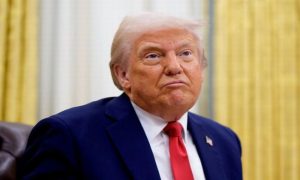
Donald Trump has been at it again. This time he has been stirring things up in the foreign exchange markets.
After the dollar fell abruptly last week, he appeared to endorse the weaker currency, saying that it was “great”. It is tempting to see this as just another one of Trump’s offhand remarks that don’t mean very much. Yet as with much else, there is method in his madness.
Also Read:Dollar steady amid rout in precious metals as investors weigh a Fed under Warsh
In fact, the dollar has been weakening over the last year but since Jan 16 it has fallen pretty quickly. It is down by over 3pc against the euro and almost 4c against the yen. Overall, its trade-weighted index has fallen by 3pc.
Also Read:Daily horoscope February 1, 2026: Today’s predictions for your star sign
In the wider scheme of things, these are comparatively small drops but there is ample evidence that the president and his acolytes actually want a much weaker dollar in order to make American goods more competitive at home and abroad.
Last week the Federal Reserve, presumably acting on the instructions of Scott Bessent, the treasury secretary, asked for a “rate check” on the US dollar against the Japanese yen, potentially a prelude to intervention sales of dollars against the yen. Indeed, a weak dollar is the second phase of a grand plan to reduce America’s trade deficit and build up American manufacturing.
Phase one was the launching of a tariff war against most of the world. Interestingly, one of the criticisms of this policy from economists was that it probably wouldn’t do much good because the dollar would probably rise in response, thereby making American goods and services less competitive on world markets and offsetting the impact of tariffs. In the event, the complete opposite happened.
Also Read:Here’s when gold could reach $10,000, according to Yardeni
The way Trump’s strategy has been carried out may have been haphazard and indeed downright dangerous, but there is definitely some sense in it. Around the world, there are many countries which are running huge current account surpluses, including China, Germany, Singapore, Norway and Switzerland. These are the counterpart to America’s huge deficit, which is running at about 3pc of GDP.
Also Read:Why JPMorgan Chase shut down Donald Trump’s bank accounts
For many countries, a deficit of this magnitude would cause their currency to weaken, thereby setting off a series of developments that would reduce the current account deficit. In America’s case, however, because of the dollar’s role as the world’s money and the role of US government bonds as the world’s ultimate safe-haven asset, investors have been more than ready to finance America’s current account deficit. The result is that the dollar has stayed too high and the current account deficit has continued.
America’s deficit is far from being a new phenomenon. The country’s current account was last in balance in 1991. The result of these continual deficits is that America’s net international asset position has deteriorated shockingly. A decade ago, there was an excess of US liabilities to foreigners over US foreign assets of about 10pc of GDP. Now, though, America’s liabilities to foreigners exceed its foreign assets by 90pc of GDP. This is a form of negative investment.
Meanwhile, with manufactured goods featuring so strongly in international trade, America’s trade deficit has been a significant (although by no means the only) factor behind the country’s low share of manufacturing in GDP.
Also Read:Musk says steps to stop Russia from using Starlink seem to have worked
So you can see the motivation behind the wish for a weaker dollar. But if Trump is going to succeed, more loose talk and intervention on the foreign exchange markets, hinted at or actual, probably won’t be enough. He will need lower interest rates.
Yet the downside of the fact that the American economy is growing vigorously is that this leaves the Federal Reserve unlikely to cut interest rates by more than 0.25pc this year, and perhaps not at all.
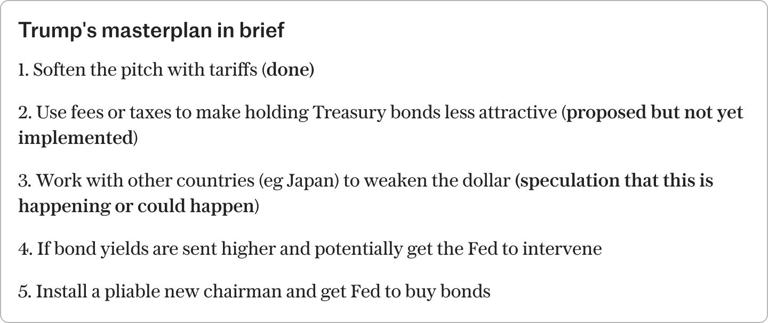
This explains why Trump has been so keen to lambast Jerome Powell, the soon-to-retire Fed chairman, and to try to manoeuvre various supporters and sympathisers onto the Fed’s board, and hence onto the Open Market Committee, which sets interest rates. Trump has just announced that Powell’s successor will be Kevin Warsh, no one’s stooge but likely to be an interest-rate dove.
Trump could soon reach the point when the Fed will deliver big rate cuts. This could extend to buying US Treasuries if their yields rose significantly in response to this policy or other factors.
And if he does succeed in his endeavours, then long Treasury yields would surely rise. For a start, a much lower dollar would increase US inflation but, more importantly, the markets would fear what a politicised Fed would imply for the future. Longer-term, the undermining of Fed independence, coupled with all the other things that Trump has said and done, threatens to erode trust in US institutions and to end the hegemony of the dollar.
Also Read:Daily horoscope January 31, 2026: Today’s predictions for your star sign
Thinking more parochially, the stronger pound could be seen to strengthen the case for an interest rate cut when the Bank of England’s Monetary Policy Committee (MPC) meets this week. In fact, I doubt that it will make much difference. It has recently risen from $1.35 to $1.38 but its average value, given by its trade-weighted index, has only risen by 1pc. The MPC is likely to welcome the slight disinflationary effects of this, without being goaded into an early rate cut.
Things could be a bit different, though, in Europe. If the dollar carries on weakening then the ECB might be persuaded to cut interest rates, since inflation in the eurozone is already at the target. Meanwhile, the Swiss National Bank could be forced to cut interest rates into negative territory to try to restrain the surging Swiss franc.
The pound may have risen a bit against the dollar, but against the Swiss franc it is down and, indeed, it is not far off parity. Those readers about to go skiing in Switzerland should beware. A cup of coffee on the mountains is going to be a bruising experience.
Source :Msn