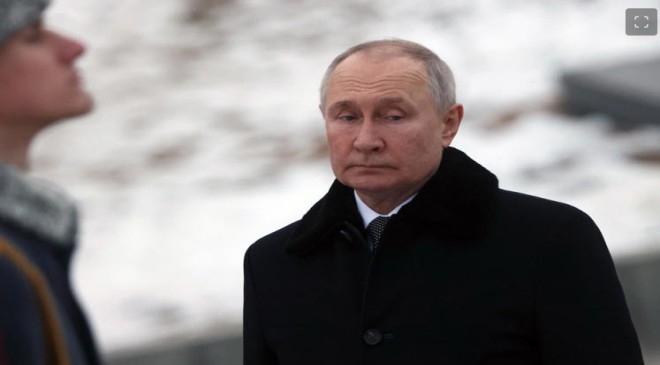
Donald Trump and Vladimir Putin are heading to Alaska to discuss the possibility of a negotiated end to the war in Ukraine, but some observers fear that the Russian president isn’t bothered about making peace. They assess that Russia is prepared to fight indefinitely, with Putin believing that he can outlast Ukraine in terms of weapons and manpower.
As a former US intelligence officer, specialising in Putin’s thinking and Russia’s war-fighting strategy, I participated in dozens of wargames, simulating conflicts similar to the one in Ukraine, in which US/Nato forces eventually intervened. When leading the Red Team (Russian forces) – comprised of Russia analysts from across the intelligence community – against the Blue Team (US/Nato forces), my colleagues and I ran our campaign just as we assessed the Russian president and his military would.
Also Read :Dear Tesla Stock Fans, Mark Your Calendars for September 30
Based on that experience, here is what I consider to be Putin’s decision calculus.
He is unlikely to think that he needs to fight “indefinitely”. Instead, he may have determined that he only has to fight long enough to inflict what Russian military planners call “unacceptable damage” – to both Ukraine’s combat potential and to the morale of the country’s troops and civilian population. The result would be Ukraine’s capitulation.
Based on the calculations of the Russian General Staff, Russia’s significant advantage in combat potential over Ukraine – even when including military assistance from the US and Europe – and its historically-proven tolerance for casualties, will enable Moscow to outlast Kyiv and its Western supporters. From the intelligence standpoint, this rationale has its logic.
Also Read : Tariffs On India’s Russian Oil Purchases ‘Big Blow’ To Moscow, Says Trump Before Putin Meet
In terms of combat potential – a combination of the size of a country’s weapons stockpile, the size of its armed forces, its ability to mobilise additional troops, its military-industrial capacity to scale up production of weapons, and its will to fight – Ukraine is outmanned, outgunned, and overly reliant on the West economically and militarily. Its will to fight also appears to have been eroded. Despite having lowered the minimum conscription age in 2024 from 27 to 25, and allowing men over 60 to enlist in the military, Ukraine is in a manpower crisis, with the average age of a Ukrainian soldier reportedly having reached 45.
Ukraine faces critical shortages in key weapon systems and ordnance, forcing it to ration its ammunition, especially artillery shells. Russia’s disproportionate advantage over Ukraine in artillery shell use – 44,500 vs 14,600 in the summer of 2024, according to one estimate – has hindered the Ukrainian military from fighting effectively and appears to have drained its troops’ morale.
Supplies from the US and Europe are not endless, either, because their respective arsenals have also been depleted. In July, the Pentagon even ordered a temporary pause on deliveries of munitions to Ukraine. The Pentagon apparently deemed it crucial to conserve its stockpiles of Patriot interceptors, Howitzer munitions, Hellfire missiles, GMLRS precision-guided missile systems, Stingers, AIM air-to-air missiles and grenade launchers. The fact that some deliveries were rapidly restored does not mean the stated rationale for the pause was incorrect.
Indeed, the Pentagon must maintain a sufficient weapons arsenal to meet the requirements of its geographical combatant commands, which are responsible for military operations in their respective areas of responsibility. Each of these commands keeps war plans on the books for likely future conflicts and these plans must be resourced with the necessary munitions to prosecute a successful campaign. Having strained the US stockpile significantly, due to its extremely high burn rate of munitions (at least by Western standards), Ukraine cannot count on years of additional arms shipments.
With the threat of China looming large, there’s grave concern among US military planners that the US would probably fail at any future intervention. According to the 2024 report by the Commission on the National Defence Strategy, the US military “lacks both the capabilities and the capacity required to be confident it can deter and prevail in combat”. In a great power conflict with Beijing, it warned that the US would likely run out of munitions in three to four weeks, with some weapons systems lasting only a few days. The same report assessed that the US military was inadequate for a multi-theatre conflict to “defend the homeland and tackle simultaneous threats in the Indo-Pacific, Europe, and the Middle East”. More alarmingly, US industrial production is “grossly inadequate to provide the equipment, technology, and munitions needed today,” let alone for future conflicts.
Also Read : ‘Washington DC Murder Rate Three Times Higher Than Islamabad’: Trump Takes Control, Deploys National Guard
In contrast, Russia, having moved onto a wartime footing seven years prior to the invasion of Ukraine, is now believed to be producing more ammunition in three months than Europe in one year. Putin has also increased the size of Russia’s armed forces, to ensure that they can fight until the last Ukrainian. Given the current level of attrition of Ukraine’s manpower and munitions and the West’s limited ability to restock supplies, Putin highly likely believes that Ukraine and the West are nearing the point of “unacceptable damage”, eventually compelling them to abandon the fight. A recent Gallup poll revealed that 69 per cent of Ukrainians now favour a negotiated end to the war with Russia.
While both Russia and Ukraine have suffered tremendous losses thus far, with a population three times larger, Russia is better placed to fight a multi-year war of attrition. Russia’s fear of a US-Nato intervention on the battlefield in Ukraine is likely to be mitigated by the assessment that neither the Americans nor Europeans, culturally or psychologically, would be willing to sustain the scale of human loss required for this type of land war of attrition. Indeed, it’s hard to imagine Western leaders summoning up the political will to throw their troops into the meat grinder of an adversary whose centuries-old way of war centres on out-suffering and outlasting its opponent. Having lost millions of people in the Second World War, Russians believe they have a much higher pain tolerance.
War-gaming has suggested that, in a large-scale war with a near-peer adversary, such as Russia and China, the US and its allies would suffer thousands of casualties in the first few weeks of the conflict. With 24,000 casualties incurred each month, as assumed by US Army doctrine, the US military would have to “almost immediately request reauthorisation of the draft to ensure it had sufficient manpower to sustain the war,” according to US military planners. The idea of returning to conscription remains unthinkable for many Europeans and Americans, and could be political suicide for Western leaders.
In contrast, Putin has been mobilising overtly and covertly throughout this conflict and will almost certainly approve a bill recently submitted to the State Duma, introducing year-round conscription for military service.
Putin is highly unlikely to make any concessions to Trump in Alaska. My assessment is that he firmly believes Moscow holds the upper hand. While Trump’s goal is to stop the killing in Ukraine, Putin’s likely goal is to appear next to the leader of the free world, demonstrating not only that Russia is not as isolated as the West thinks, but is an equal to America. Without a thorough understanding of Putin’s Playbook, Trump’s art of negotiating will not produce the deal.