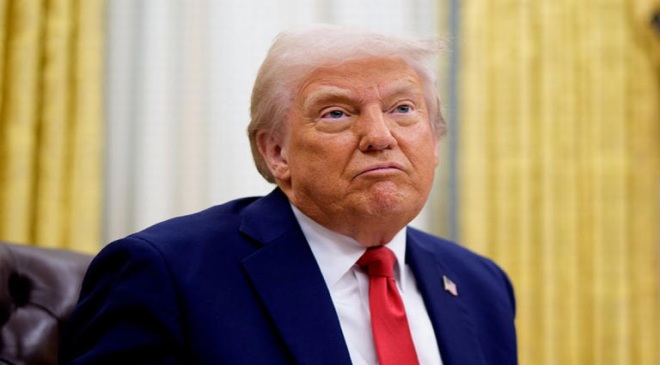
Financial experts have sounded the alarm ahead of Donald Trump’s ‘Make America Wealthy Again’ speech at the Rose Garden, where he is expected to announce new tariffs with massive consequences globally.
Trump’s 4 p.m. announcement will help understand what the reciprocal tariffs will look like, how many countries will be affected and how high the duties will be. While he had initially planned to levy tariffs on Mexico, Canada, and China, over the weekend, the president announced that “all countries” can expect to see tariffs being imposed.
Read More:-Trump ‘eats his words’ after Wisconsin Supreme Court win amid ‘cheating’ rant
According to Trump, Wednesday will be similar to ‘Liberation Day’ for Americans. However, the American businesses, financial markets, and economic experts are far from convinced.
“Tariffs are economically detrimental, and these, no matter how you try to spin them, are no exception to that rule,” Blanco told Mirror US. “Economically speaking, the only silver lining that I could possibly think of for all of the tariff policy that has been implemented in the last two months is that maybe people will realize how absolutely terrible tariffs are, and then really press their elected officials to just absolutely abandon this economic hand grenade that we seem to be trying really, really hard to be holding in our hands when it explodes.”
Read More:-Trump hints that Musk and DOGE may be coming to the end of the road
Here, we break down some of the areas that could be impacted, according to experts.
Effect on GDP:
“My greatest concern has been the uncertainty and the continued uncertainty,” Villamil told Mirror US, adding that this is ultimately hurting consumers and firms.
“If consumers don’t know what’s happening, they’re going to cut back on their consumption. And that’s a huge part of GDP,” Villamil added.
Consumers, especially low-income individuals or families and elderly people on a fixed income, will particularly feel the pinch if goods and services become expensive.
Read More:-‘Worst fears coming true’: Conservative WSJ hits Trump for letting Cabinet member run amok
Consumption makes up a lion’s share of the United States’ GDP.
According to the U.S. Bureau of Economic Analysis, private consumption expenditures made up nearly 68% of the nation’s GDP in the fourth quarter of 2024.
While the Trump administration is focused on bringing a lot of outsourced or offshored industries back to the nation, the United States may not be poised for the economic transition yet. Building factories overnight to produce goods that come into the country is impossible.
It also “ignores” fundamental insights from basic economics related to liberal trade networks, Blanco said, where the US gets some goods cheaper as other nations are better situated to produce them.
If domestic production is more costly, it is “difficult to see how it’s going to help lots of people,” Villamil said, adding that transitioning to a different economy takes a while.
Eighty percent of the aluminum in the US is imported from Canada “because Canada has a comparative advantage in producing that good” due to an abundant supply of hydroelectric power that helps it produce it at a lower cost, Villamil explained.
Due to high tariff rates, it will raise the costs for US firms.
“The concern is that this will lead to higher costs for firms, prices that firms have to charge, American firms have to charge, and ultimately more inflation,” she explained.
Federal Reserve Chair Jerome Powell has said that the impact of tariffs on Fed policy and inflation is difficult to gauge in advance, until it’s clearer which imports are hit with tariffs and whether other nations retaliate with their own.
But at the Fed’s last press conference in December, Powell acknowledged that some of the central bank’s 19 policymakers are starting to incorporate the potential impact of President-elect Donald Trump’s policies on the economy.
Read More:-Elon Musk wages legal battle to ensure more Tesla cars hit the market: ‘It is no coincidence’
“Some people did take a very preliminary step and start to incorporate highly conditional estimates of economic effects of policies into their forecast at this meeting,” Powell said. Other officials did not take such a step, he said, while some didn’t specify whether they did so.
Other Fed officials have recently suggested that the Fed will move more slowly on rate cuts this year, after cutting at each of its last three meetings in 2024.

Market reaction:
The S&P 500 was 0.7% lower in early trading Wednesday morning, but it’s had a pattern this week of opening with sharp losses only to finish the day higher. The Dow Jones Industrial Average was down 240 points, or 0.6%, as of 9:35 a.m. Eastern time, and the Nasdaq composite was 0.9% lower.
Tesla helped pull the market lower after it said it delivered fewer electric vehicles in the first three months of the year than it did in last year’s first quarter. Its stock fell 4.7% to extend its loss for the year so far to nearly 37%. Tesla, one of Wall Street’s most influential stocks, has faced growing backlash due to anger about CEO Elon Musk’s leading the U.S. government’s efforts to cut spending.
The volatility of the financial markets is a result of regime uncertainty, explained Blanco. Regime uncertainty or policy uncertainty is a class of economic risk where the future of government policy cannot be predicted.
“Markets don’t like uncertainty,” Blanco said. “If people don’t have confidence in what the government’s policies are going to be in the near or immediate future, they’re not going to plan, or rather, they’ll defer.”
This “wait and see approach” is really “detrimental,” Blanco warned.
Global reaction:
The uncertainty of the situation will hurt America’s position as a reliable trading partner, a stark contrast to its decades-long reputation, Blanco cautioned.
“Not only is the US unreliable, but frankly unfriendly,” she said.
This might lead to countries diversifying and trying to find different trading partners.
The European Union has issued a chilling warning to Trump’s tariff plans.
“Europe has not started this confrontation,” Ursula von der Leyen, the head of the European Union’s executive, said in a speech.
“We do not necessarily want to retaliate, but if it is necessary, we have a strong plan to retaliate, and we will use it,” she added. “We will approach these negotiations from a position of strength. Europe holds a lot of cards, from trade to technology to the size of our market,” she continued. “But this strength is also built on our readiness to take firm countermeasures if necessary. All instruments are on the table,” she said.
While Von der Leyen did not elaborate on how the EU might respond, the bloc had responded to Trump’s steel and aluminum tariffs in March by announcing countertariffs worth $28 billion on American goods, namely boats, bourbon, motorbikes, and more.
Are we hurtling towards a recession or a stagflation?
The United States is currently not in recession but there continues to be growing concerns about the economy softening due to a decline in consumer sentiment, Villamil explained. While the lack of confidence among consumers and businesses in investing in the economy may trigger a recession, there is not one now, she assured.
However, the United States’ steady run towards de-globalization may lead to slower growth, which leads to stagflation.
A lower growth or stagnation in the economy coupled with tariff-induced inflation can lead to stagflation, she said.
“Stagflation is very painful. It’s the worst of slow growth and inflation and it led people to be very unhappy,” she said, referring the the 1980s when unemployment was over 7.5% with a 14.5% inflation rate.